Oil

NEW -> Contingent Buyer Assistance Program

1781806860384.png

National Average Drops Below $4/Gallon as Summer Travel Heats Up​


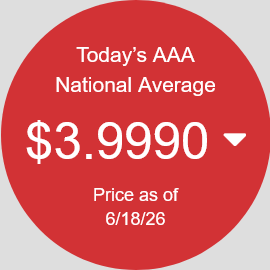
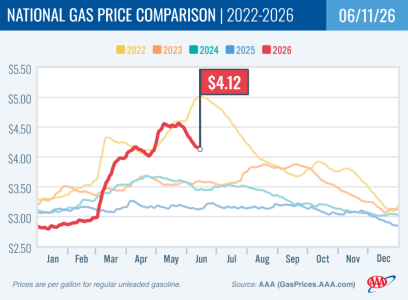
WASHINGTON, DC (June 18, 2026) – Drives are getting a break at the pump as the summer travel season heats up. For the first time since Mach 30, the national average for a gallon of regular gasoline is down to $3.99. This marks nearly 4 straight weeks of declines. Crude oil prices are down as the U.S. and Iran reach a deal to reopen the Strait of Hormuz. Sliding gas prices come as millions of Americans prepare to travel for Independence Day in record numbers starting next weekend.

Today’s National Average: $3.999

One Week Ago: $4.129

One Month Ago: $4.515


1781806759448.png
 
AI does not agree:

The Plot Twist: It Didn't Work as Intended

If the goal was to cripple China's economy by starving it of energy, it largely backfired.
While China's oil imports through Hormuz hit a decade low, its economy barely flinched. Analysts note that China's massive, 25-year push into domestic electrification, solar power, and Electric Vehicles (EVs) acted as a perfect shock absorber. Furthermore, the restriction just pushed China to import even more pipeline oil and gas overland from Russia and Central Asia, entirely bypassing the US-controlled oceans.

So, while the US did use its naval dominance to heavily restrict who got oil out of the open strait, China managed to weather the storm.

EVs for the win? 😁
 
AI does not agree:

The Plot Twist: It Didn't Work as Intended

If the goal was to cripple China's economy by starving it of energy, it largely backfired.
While China's oil imports through Hormuz hit a decade low, its economy barely flinched. Analysts note that China's massive, 25-year push into domestic electrification, solar power, and Electric Vehicles (EVs) acted as a perfect shock absorber. Furthermore, the restriction just pushed China to import even more pipeline oil and gas overland from Russia and Central Asia, entirely bypassing the US-controlled oceans.

So, while the US did use its naval dominance to heavily restrict who got oil out of the open strait, China managed to weather the storm.

EVs for the win? 😁
The entity is just telling you what it thinks you wanna hear🤦🏽‍♂️😆😆😆

AI Wants to Make You Happy. Even If It Has to Bend the Truth​

 
Dispute the facts.

So far you’ve just been floating Truth Social theories.
Forcing china to over rely on Russia is perfectly in line. Chinas domestic coal powered production further restricts their options to self reliance. We now control not just their energy needs but most of the worlds….drilll baby drill!!!
 
Delusional like your orange homie.

Still no non-biased facts.

And I try to ask AI in your favor because like you said, it tries to please me:

So the war on Iran was good because we now control the world's energy needs?
Not necessarily.

Even if someone believes the military action against Iran was justified, the conclusion that "we now control the world's energy needs" doesn't really follow.

A few points:

  • The United States is already one of the world's largest oil and natural gas producers, largely because of domestic production.
  • A significant share of global oil still comes from countries in the Middle East, including members of OPEC. No single country fully "controls" world energy supplies.
  • Military action can sometimes reduce threats to shipping routes or energy infrastructure, but it can also increase instability and drive oil prices higher if markets fear disruptions.
  • Global energy markets are interconnected. Major consumers such as China, India, the European Union, and others all influence demand and pricing.
  • Control over energy is not just about oil production. It also involves refining capacity, pipelines, shipping lanes, natural gas exports, renewable energy, and critical minerals.
So whether the conflict was "good" depends on the goals you're evaluating—national security, regional stability, preventing nuclear proliferation, economic effects, humanitarian costs, etc. But saying it resulted in U.S. control of the world's energy needs would be an overstatement.

But don't we control Hormuz now?
It's more accurate to say the U.S. currently has the military capability to help keep the Strait of Hormuz open, not that it "controls" it outright.

A few distinctions:

  • The Strait lies between Iran and Oman. The U.S. does not own or legally control the waterway.
  • Recent reporting indicates U.S. and allied naval forces have been escorting shipping and monitoring traffic to prevent disruptions, and oil flows have returned close to normal levels. (Reuters)
  • At the same time, shipping is still affected by mines, security concerns, and coordination involving Iran, Oman, and international organizations. The situation remains more complicated than a simple U.S. takeover. (Reuters)
  • President Trump has publicly claimed that the U.S. "controls" the Strait, but that is a political statement rather than a generally accepted legal or geopolitical description. (Al Jazeera)
So if by "control" you mean "can the U.S. Navy largely guarantee passage and prevent Iran from closing it completely?"—many analysts would say the U.S. has substantial leverage and naval superiority. If you mean "does the U.S. now own, govern, or exclusively control the Strait?"—no. The reality is closer to a contested waterway where multiple countries still have influence and where military power, diplomacy, and international law all matter. (CSIS)
 
OPEC is dead…we now control not only our own production but that of Venuzuela and now most of the Middle East between Saudi Arabia and choke points on the straits China is now beholden to our influence and supply…as it should be. Drill baby drill…watch oil prices decline further and with it inflation and the Dems midterm blue wave dreams….fear will keep them in line,,😂😂😂👍🏽🇺🇸

 
OPEC is dead…we now control not only our own production but that of Venuzuela and now most of the Middle East between Saudi Arabia and choke points on the straits China is now beholden to our influence and supply…as it should be. Drill baby drill…watch oil prices decline further and with it inflation and the Dems midterm blue wave dreams….fear will keep them in line,,😂😂😂👍🏽🇺🇸


I put that exact verbiage in ChatGPT to preserve all your biases:

That’s a coherent geopolitical argument, but it rests on several assumptions that are still very much debated.

The strongest points in favor of your view are:

* The U.S. has become a major energy producer, unlike the 1970s when it was far more dependent on imports.
* The U.S. Navy remains the world’s dominant maritime force and has enormous influence over key shipping lanes.
* Countries such as China are much more dependent on imported oil than the United States is, making them vulnerable to disruptions in maritime trade.
* Lower oil prices generally reduce transportation and energy costs, which can help lower inflation.

The counterarguments are:

* Influence is not the same as control. Even if the U.S. can protect shipping through Hormuz, oil producers such as Saudi Arabia, Iraq, United Arab Emirates, and others still decide how much oil they produce.
* China’s energy security strategy includes pipelines from Russia and Central Asia, long-term supply contracts, strategic reserves, and diversification specifically to reduce dependence on any single chokepoint.
* Oil prices depend on global supply and demand. If producers cut output, global growth accelerates, or a conflict expands, prices can rise even if the U.S. increases production.
* Historically, wars in oil-producing regions have often caused price spikes before any potential long-term benefits materialize.

As for politics, there’s certainly an argument that lower inflation and lower gasoline prices could help incumbents or the party in power. But elections are usually influenced by many factors at once—economic growth, wages, housing costs, immigration, foreign policy, and voter turnout—not just energy prices.

The bigger question is whether the current situation produces a lasting strategic advantage or just a temporary one. Many analysts would agree the U.S. has substantial leverage in global energy markets today. Fewer would agree that it now controls global energy or that other major powers are “beholden” to U.S. supply decisions. Those are stronger claims that would require a much higher degree of economic and political control than currently exists.


You are basically an exaggerator like your idol. Can’t even get AI to totally agree with you.

 
I put that exact verbiage in ChatGPT to preserve all your biases:

That’s a coherent geopolitical argument, but it rests on several assumptions that are still very much debated.

The strongest points in favor of your view are:

* The U.S. has become a major energy producer, unlike the 1970s when it was far more dependent on imports.
* The U.S. Navy remains the world’s dominant maritime force and has enormous influence over key shipping lanes.
* Countries such as China are much more dependent on imported oil than the United States is, making them vulnerable to disruptions in maritime trade.
* Lower oil prices generally reduce transportation and energy costs, which can help lower inflation.

The counterarguments are:

* Influence is not the same as control. Even if the U.S. can protect shipping through Hormuz, oil producers such as Saudi Arabia, Iraq, United Arab Emirates, and others still decide how much oil they produce.
* China’s energy security strategy includes pipelines from Russia and Central Asia, long-term supply contracts, strategic reserves, and diversification specifically to reduce dependence on any single chokepoint.
* Oil prices depend on global supply and demand. If producers cut output, global growth accelerates, or a conflict expands, prices can rise even if the U.S. increases production.
* Historically, wars in oil-producing regions have often caused price spikes before any potential long-term benefits materialize.

As for politics, there’s certainly an argument that lower inflation and lower gasoline prices could help incumbents or the party in power. But elections are usually influenced by many factors at once—economic growth, wages, housing costs, immigration, foreign policy, and voter turnout—not just energy prices.

The bigger question is whether the current situation produces a lasting strategic advantage or just a temporary one. Many analysts would agree the U.S. has substantial leverage in global energy markets today. Fewer would agree that it now controls global energy or that other major powers are “beholden” to U.S. supply decisions. Those are stronger claims that would require a much higher degree of economic and political control than currently exists.


You are basically an exaggerator like your idol. Can’t even get AI to totally agree with you.
Yah well..you and the entity still think the Straits of Hormuz is closed so keep living your best life in that reality…here in the real world oil just crashed into the $60’s and gas will soon follow (except here in Cali)…😂😂😂😂👍🏽🇺🇸
 
i’m not sad, things are beautiful here in the real world. Free yourself from the Matrix…take the Red Plll…Come join us.👍🏽😂😂😂🇺🇸
 
here in the real world oil just crashed into the $60’s and gas will soon follow (except here in Cali)…😂😂😂😂👍🏽🇺🇸

CA Democrats punish the working poor with the nation's highest gas tax.

Thanks to a law, gas prices in California will go up on July 1st​


California gas prices are about to climb again. A 2.2-cent-per-gallon gas tax increase takes effect July 1, adding to an already steep per-gallon tax burden that leaves drivers in the state paying some of the highest fuel prices in the nation.

When other fees and sales taxes are factored in, about $1.20 of every gallon purchased in California goes toward fees rather than the fuel itself.

 
Back
Top