IrvineRenter said:
I apologize if you were not giving a sales pitch. Given your screen name, and the realtorese you were spouting, it was a natural reaction. It looks as if you are still suffering from kool aid intoxication. Perhaps if you read through some of the analysis posts, you can begin the detoxification process.
"If you bought a few years ago, and you can actually afford your house, you'll be fine." I suggest you read
Timing Does Matter
"Only about 5-10% of the market is setting the prices right now." Only about 5%-10% of the market sets the prices all the time. Market prices are always set at the fringes.
"Luck is only required for the people who try to time the market." Luck can be very helpful, but careful analysis and an understanding of
fundamental value can greatly increase one's chance of getting lucky.
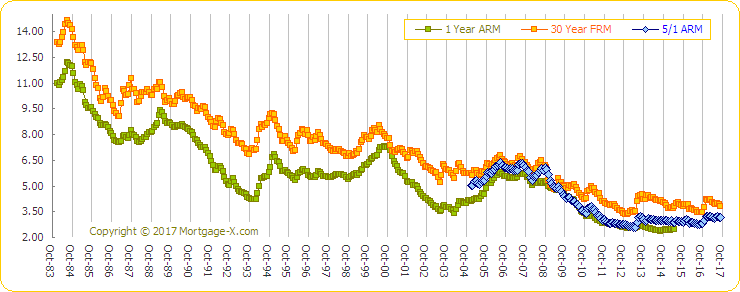
"statistical evidence says that you're net worth will increase." Actually, if you don't time the market properly, you will not see an inflation adjusted return. People who bought in 1990 waited 10 years to get back to breakeven. During that 10 years inflation reduced the value of the dollar 25%. By the time we get to the bottom of this bubble cycle, all the "statistics" about making money in real estate will need to be rewritten. If you want to research the true
Investment Value of Residential Real Estate, click the link.
I respect the approach that you have taken and the viewpoint that you have. I admit that some of these statements were a bit generic and don't apply in all situations. I also agree that you should take your time and look for the best deal that meets your needs. A more academic approach would benefit many people if they applied the discipline that you have.
If I may, I would classify your position as a sophisticated investor with a current viewpoint that is bearish. The primary audience that I was writing for is the owner-occupied individual(s) who may be in a current state of panic. Where the conversation becomes muddied is when investment models co-exist with the choice of a primary residence. In many ways we're both right.
My primary thesis is this: More wealth is destroyed by frequently changing your primary residency (as an owner) and by not considering a business model when choosing a property to purchase (as a backup for owner-occupied OR as a foundation for an investment property)
Both of these points are based on the Southern California housing market.
Here are some of the reasons why:
- Prop 13 gives a competitive advantage to long-term holders of CA real estate
- Selling a property to purchase another will at a minimum destroy 6% of your existing equity
- If you pay points to reduce your interest rate and then you sell the property before you've broken-even you've destroyed wealth
- Some investors fail to consider the various business models, and contingency plans, for a property that they are purchasing. They only take a macro-economic approach instead of considering the micro-economic realities of the unique piece of property. (Note: This was more true a few years ago when the excitement of real estate brought in to many unqualified investors).
- If you're purchasing a property for a primary residence you should also consider the business models if you were to turn it into an investment property. While you're decision may be based on emotion or your current situation the future value will be determined by the merits of the property and what type of listing it will have in the MLS (i.e. Sale or Lease)
- Making a property into an "investment" will incur costs for property management, accounting, and marketing regardless of who does the work (i.e. yourself or someone you hire). Failing to consider these costs or the opportunity cost will have a negative impact on your ROI.
- On balance, be prepared to recognize unexpected successes and unexpected failures. Rapid increases may give you reason to sell. Rapid decreases may give you reason to buy. (i.e. buy low sell high; sell high buy low).
- It's best if real estate is one of multiple asset classes that you own. (i.e. it's bad to be house rich & cash poor).
- While some appreciation can be attributed directly to inflation, if the asset is properly leveraged (i.e. with consideration to cash-flow), the purchase cost will also effectively decrease as you use the future value of the dollar to pay the principle & interest that was established in the past. To say it another way, a properly leveraged asset is a hedge against inflation.