University of Georgia - Athens, GA

NEW -> Contingent Buyer Assistance Program
UGA is on the Rise!

University of Georgia's US News ranking was #58 in 2010, today UGA ranks #46. Georgia Tech was #35 back in 2010 and today ranked #33. Just like USC caught up to UCLA, I belive that UGA will be in par with Georgia Tech in the next decade. Univ of Texas was ranked #47 in 2010 and today ranks in the top 30. UGA is on the same trajectory as UT-Austin. I think both UGA and Georgia Tech will be ranked right in that top 25-30 spot in the US News ranking within the next 10 years.

2023 Acceptance rate 37%
2024 Acceptance rate 32.9%
2025 Acceptance rate 28-29% (Panda's Prediction)
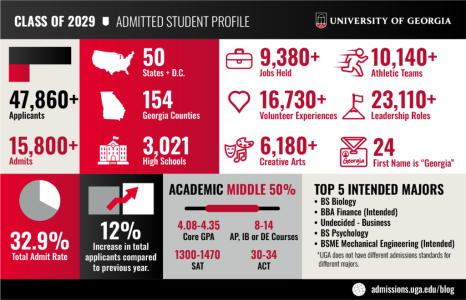
UGA-Admissions-2029-Graphic-1024x660.pnguga.jpg
 
Last edited:
Wealth Management

The average cost of private school from kindergarten through 12th grade in the United States ranges from $10,000 to $20,000 per year. Let's take the average of $15,000 per child. For a family of 4 ( 2 children ) who attend private school from k-12 is $360,000.

Private College for two kids is another $300,000 + $300,000 = $600,000. Total cost on Education for 2 kids attending Private School from k to 12 + Private College is $960,000. Let that sink in for a moment.

Asian Parents in the east coast and the west coast seem to enjoy bragging about this which Panda doesn't seem to understand? Why?
 
Last edited:
Wealth Management

The average cost of private school from kindergarten through 12th grade in the United States ranges from $10,000 to $20,000 per year. Let's take the average of $15,000 per child. For a family of 4 ( 2 children ) who attend private school from k-12 is $360,000.

Private College for two kids is another $300,000 + $300,000 = $600,000. Total cost on Education for 2 kids attending Private School from k to 12 + Private College is $960,000. Let that sink in for a moment.

Asian Parents in the east coast and the west coast seem to enjoy bragging about this which Panda doesn't seem to understand? Why?
Also factor in a gap year some grads take between high school and college for travel.
 
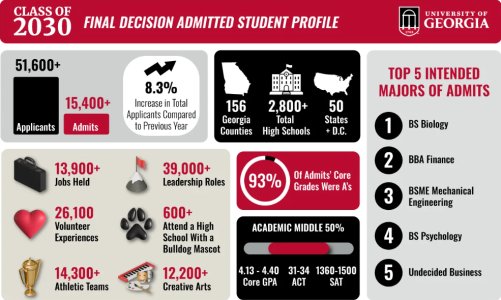
On August 13, 2025, I projected an acceptance rate of 29% for the University of Georgia. Looking at broader trends, the 2010–2020 decade can be characterized as the era of Georgia Tech’s surge in selectivity and applicant growth. In contrast, the 2020–2030 decade appears to be shaping up as the University of Georgia’s wave.

We’ve seen this pattern before at peer institutions. When the University of Florida and the University of Texas each reached around 70,000 applicants, the following year brought a dramatic spike to roughly 90,000. This kind of inflection point suggests a tipping effect in national visibility and demand.

Given these precedents, it’s reasonable to expect a similar trajectory for UGA. If application growth accelerates in the same way, the acceptance rate could fall into the teens by the 2030–2031 admissions cycle, marking a significant shift in the university’s selectivity and positioning.

2030.jpg
 
Last edited:

Ranking of Colleges with the Best Student Life in America.

Rank #1 USC
Rank #2 UGA
Rank #3 UCLA

The acceptance rate at the University of Georgia was just under 50% in 2020, and I expect it to drop into the teens by 2030–2031 similar to the trajectory the University of Southern California experienced in the late 1990s and early 2000s. If investing in UGA is anything like investing in real estate, Panda is going ALL IN.
 
Last edited:
What’s the out of state and international student percentages in UGA vs the top UC’s, this could be a proxy to see how desirable these schools are from an “investment” perspective.
 
What’s the out of state and international student percentages in UGA vs the top UC’s, this could be a proxy to see how desirable these schools are from an “investment” perspective.
Hi Ravi.

Georgia’s public universities are increasingly positioning themselves alongside top-tier national institutions in both selectivity and value. Georgia Institute of Technology now demonstrates admissions competitiveness comparable to leading UC campuses such as University of California, Los Angeles and University of California, Berkeley, with acceptance rates falling into the low teens.

At the same time, University of Georgia is trending toward selectivity levels similar to 2nd-tier UC schools like University of California, Irvine and University of California, San Diego, with acceptance rates in the 20% range.

What truly differentiates Georgia, however, is the strength of its in-state financial support. The HOPE Scholarship covers 100% of in-state tuition for eligible residents, creating a compelling value proposition that is difficult for many out-of-state public systems to match. Florida is the only other state offering a similarly robust statewide scholarship program.

From a return-on-investment perspective, this level of financial support significantly reduces the cost barrier to accessing high-quality education. As a result, even highly ranked UC institutions may find it challenging to compete with Georgia’s public universities when total cost and long-term value are taken into account for in-state students.
 
Last edited:
Hi Ravi.

Georgia’s public universities are increasingly positioning themselves alongside top-tier national institutions in both selectivity and value. Georgia Institute of Technology now demonstrates admissions competitiveness comparable to leading UC campuses such as University of California, Los Angeles and University of California, Berkeley, with acceptance rates falling into the low teens.

At the same time, University of Georgia is trending toward selectivity levels similar to 2nd-tier UC schools like University of California, Irvine and University of California, San Diego, with acceptance rates in the 20% range.

What truly differentiates Georgia, however, is the strength of its in-state financial support. The HOPE Scholarship covers 100% of in-state tuition for eligible residents, creating a compelling value proposition that is difficult for many out-of-state public systems to match. Florida is the only other state offering a similarly robust statewide scholarship program.

From a return-on-investment perspective, this level of financial support significantly reduces the cost barrier to accessing high-quality education. As a result, even highly ranked UC institutions may find it challenging to compete with Georgia’s public universities when total cost and long-term value are taken into account for in-state students.
Agree from an in state tuition and value perspective, UGA is best for kids in GA, UA is best for Arizona kids, UC’s are best for kids in CA and so on. But my point was more about optics/desirability since you specifically mentioned “investment”. After all just like real estate, optics matter. That’s why I asked about the difference between the out of state and international student % in the top UC’s vs UGA.
 
Ravi.

Georgia schools like Georgia Institute of Technology and University of Georgia tend to have a smaller international student percentage compared to the University of California system—likely around 8–10% for Georgia Tech and 4–5% for UGA, versus much higher shares at UC campuses.

Part of this difference comes down to global brand recognition and history. The UC system has been widely established and recognized internationally since the late 20th century, while UGA is still growing its visibility outside the U.S.

A useful comparison is at the city level: places like Johns Creek represent newer, fast-growing communities that are gaining prominence, whereas Irvine is a more mature, internationally recognized hub with a longer track record of attracting global residents and families.

In that sense, UGA can be viewed as a strong but still emerging “brand on the rise,” while UC schools benefit from decades of global exposure. As a result, awareness of UGA is still more regionally concentrated, with fewer people internationally being familiar with it compared to UC institutions.
 
Last edited:
Back
Top