ICE or EV?

Which car(s) will you be buying next?

  • ICE ICE Baby (morekaos dinosaur option)

    Votes: 16 34.0%
  • EV forEVa (unicorns for all)

    Votes: 24 51.1%
  • PHEV (I still have range anxiety)

    Votes: 5 10.6%
  • Hybrid (can't plug in yet)

    Votes: 5 10.6%
  • Alternative fuel (Hydrogen, vegetable oil, etc)

    Votes: 0 0.0%
  • Other

    Votes: 1 2.1%

  • Total voters
    47
NEW -> Contingent Buyer Assistance Program
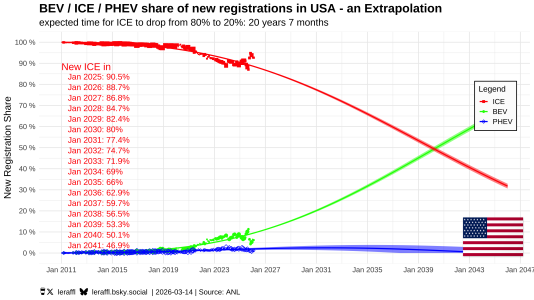
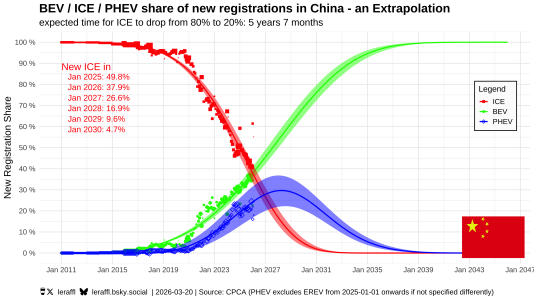
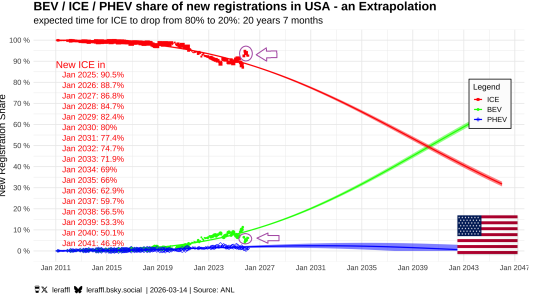
Notice the data points since the expiration of the tax credit have not been favorable for electric. The time to EV adoption is going to extend well past 21 years if this new trend continues. And this chart is just for new car registrations, not used, so the percentage of EV vehicles on the road will still be well below 80% in the year 2047 unless something drastically changes.

1774564834792.png
 
Looks right.

Transportation evolution takes time.

What could accelerate this is cost, range, infrastructure and time to charge.

In 20 years maybe teleportation will hit. 😁
 
Just returned from another full FSD drive back from SJC. I was a little under the weather and with sunglasses on to mitigate Attention Monitoring you can actually doze off for a minute here and there. Life changing technology. Gas in the Bay Area already close to $7. My forecast for $10 starting to look low - pretty sure we’ll hit at least $15 over the next 2 years as the refinery desert effect takes hold. Enjoy it ICErs.
 
Just returned from another full FSD drive back from SJC. I was a little under the weather and with sunglasses on to mitigate Attention Monitoring you can actually doze off for a minute here and there. Life changing technology. Gas in the Bay Area already close to $7. My forecast for $10 starting to look low - pretty sure we’ll hit at least $15 over the next 2 years as the refinery desert effect takes hold. Enjoy it ICErs.
With Tesla's having the highest fatality rate of any car maker on the road, and death-by-Tesla being particularly fiery and gruesome due to the lithium ion battery heating to extreme temperatures, I wonder if you are placing too much faith in this technology?
 
The only reason Volvo and Polstar even exist still is because the Chinese government funds them, otherwise their EV bets would have destroyed them. Sooner or later they will probably fail anyway. Can’t hold up the sky forever.China is on the ropes…🤷🏽‍♂️👎🏽🦄🌈

Volvo leans on Chinese parent Geely to survive in tough car market​

  • Geely Holding chair Li Shufu says isolation is 'self destructive'
  • Volvo chair says survival depends on deeper ties with Geely brands
  • Samuelsson accelerates integration
  • Volvo Cars to convert $274 million of Polestar debt into shares
  • After deal, Volvo Cars to own 19.9% of Polestar Geely Holding
 
She can afford the gas for classic Ford Bronco :D

Poorer plebians like me will have to make do with a Toyota hybrid instead of... de tomaso pantera (same Ford v8). :(
My buddy many years ago bought Dallas Raines’ Pantera after befriending him at the gym - with a 501. Said it was a total beast
 
Norway achieved widespread EV adoption by taxing the poor to subsidize the rich, similar to the strategy the US has used but on a larger scale. EV buyers were being subsidized an average $27,000 in VAT tax savings per vehicle, while poor people still mostly rode bikes.

At the time of this article, Norway spent more on EV subsidies for the rich than they did on their military budget!!


-----------------------------------------------------------------------------------------------------------------------------

Why Norway — the poster child for electric cars — is having second thoughts​


So I flew across the Atlantic to see what the fuss was about. I discovered a Norwegian EV bonanza that has indeed reduced emissions — but at the expense of compromising vital societal goals. Eye-popping EV subsidies have flowed largely to the affluent, contributing to the gap between rich and poor in a country proud of its egalitarian social policies.

Although the EV policies were fueling a car-buying frenzy for affluent residents, they offered little to those of limited means. Many low-income Norwegians do not own a car: In Bergen, for instance, 67 percent of households in the lowest income quartile go without one. One recent study found the likelihood that a Norwegian household would purchase an EV rose 26 percent with each 100,000 Norwegian Krones (around $11,000) in annual income, suggesting that electrification subsidies — which ballooned to $4 billion in 2022, equivalent to 2 percent of the national budget — have redistributed resources toward the rich.

 
Isn't that skewing to the wealthier just a reflection of who buys new cars (that are more expensive in Europe)? Poorer people don't have the wherewithal to purchase a new car here in the US, either.
 
Back
Top